What we found when we went looking for fraud in customer data
 Jaye Hackett
Last month we wrote about our new data pilots.
We are now screening the historic portfolios of several large consumer lenders and equivalent financial institutions against our real-time network, and analysing the fraud risk in their existing customer base.
Here are some preliminary results and insights the pilots we’ve done so far had in common.
A 10x uplift in fraud detection
This is the big one. One dataset of fifty thousand customer records contained 0.5% that were already known to be fraudulent.
By adding our extra signals, we credibly separated 4.8% of those records from the rest – a 10x uplift in fraud detection.
That’s over two hundred loans given to people likely to be stolen identities, first-payment defaults or part of coordinated attacks.
Some obvious signals are being ignored
Lenders are used to checking credit files. The best lenders compile scores across multiple bureaus to make the most informed decision about affordability and fraud risk.
Vouchsafe itself now uses multi-bureau checks and other official data sources to find trusted, independent evidence of an identity existing in the world, so they can be onboarded in a compliant way.
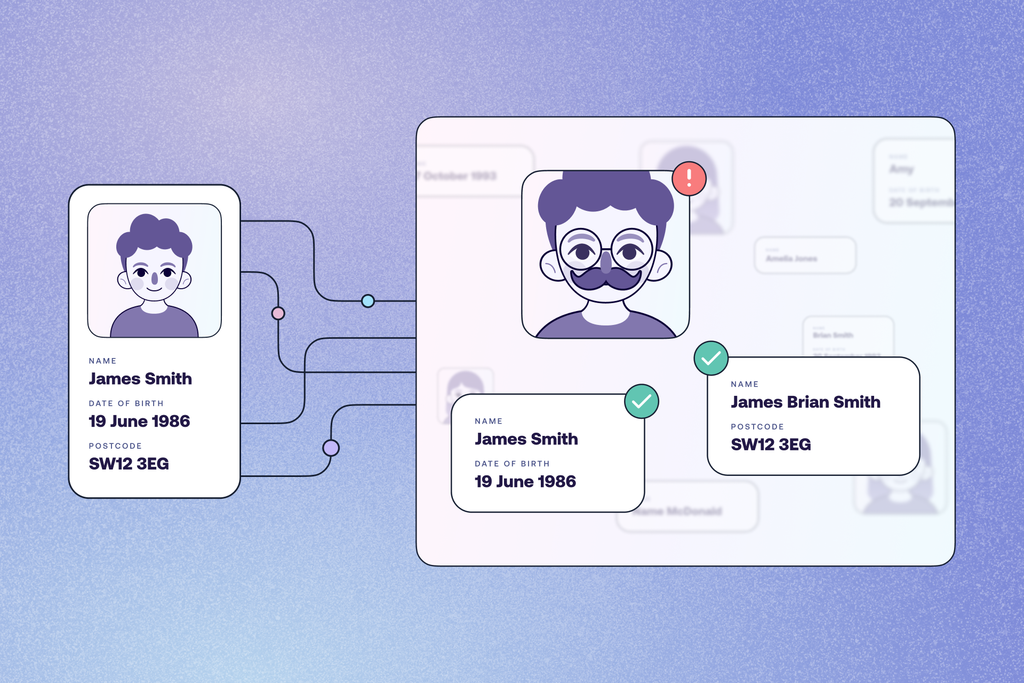
But these data sources often just operate on name, date of birth and address.
Phone number and email address are incredibly informative data points that legacy data sets ignore.
We find 5-10x more matches using these data points, and in turn spot more suspicious patterns and join more applications that otherwise look unrelated.
We also detect the online footprint associated with an email or phone number, which is very predictive of overall fraud risk.
Some of the riskiest customers had strong conventional identity checks
Some of the highest-risk customers still had strong matches across conventional identity sources.
That is not surprising when identity is stolen. A fraudster can present a real name, date of birth and address, and those details can corroborate cleanly across multiple independent sources.
A 2+2 style identity check meeting the Money Laundering Regulations 2017 standard can confirm that an identity exists. It cannot by itself confirm that the person applying is the rightful owner of that identity.
That is why identity risk has to be monitored beyond onboarding, using real-time signals from outside the original application, especially those shared between businesses.
Thin-file customers weren’t always the risky ones
The reverse was also true: customers with thinner credit files were not necessarily higher risk.
A limited electoral roll history, young credit file or recent house move can make an applicant harder to corroborate, but that does not make them fraudulent.
Taking into account their real-time activity across the Vouchsafe network now routinely helps lenders separate thousands of customers who were genuinely unusual from those who just had less legacy data available.
What does it mean for lenders?
Many lenders verify identity based purely on background data checks, both for the applicant’s ease of use and to cut manual document handling.
Multi-source identity verification performs better than relying on a single credit bureau or data source.
Things like how many accounts an identity has and how long they have existed for, whether they agree on things like data of birth as well as with other evidence on file like open banking connections, all give more confidence that an identity exists.
But they are still largely point in time checks.
They are not the same thing as true fraud intelligence: looking beyond your own organisation to see whether those details are suspicious, and knowing if fraud risk has changed since you first onboarded someone.
Are you interested in running a data pilot with Vouchsafe? You’ll get an instant sense of ROI, with a quick one-week turnaround and no integration needed. Book a call or email jaye@vouchsafe.id to learn more.