What we’re looking for at Money20/20
 Jaye Hackett

Team Vouchsafe is heading to Amsterdam for Money20/20 Europe.
It’s one of the biggest financial services and fintech events in the world, and a good place to spot what the industry is about to start caring about.
The things discussed at Money20/20 have a habit of turning into next year’s product roadmaps, regulatory priorities and board-level risk conversations.
This is what we’ll be looking for.
The end of one-size-fits-all identity
Digital IDs are going live all over the world.
Some are being built by governments. Some by banks and private sector consortia like ConnectID. Many will be reusable credentials that live in wallets. Some will prove a full identity. Others will just prove one thing: age, address, right to work, professional status, authority to act, or ownership of an account.
That means the future of identity is not one universal digital ID.
It’s a plurality of digital evidence.
This matters because in most jurisdictions, digital ID will not be mandatory to possess.
But acceptance is moving in the opposite direction.
Banks, fintechs and regulated firms are increasingly going to be expected to accept trustworthy digital evidence when a customer presents it, rather than forcing everyone through the same rigid “passport or driving licence” journey.
The winners will be the firms that can work with lots of different kinds of evidence, understand what level of assurance each one gives them, and route customers appropriately.
The losers will be the firms still pretending identity verification begins and ends with a picture of a document.
AI-powered fraud is breaking the old model
The age of purely visual document checks is over.
They were built for a world where documents were hard to fake, fraudsters worked at human speed, and biometrics could control a lot of risk.
But that world has gone.
The latest AI models make it trivial to generate convincing-looking documents, edit images, create synthetic identity material, and increasingly imitate people’s faces and voices, and automate the whole thing at scale.
Fraudsters no longer need to be particularly sophisticated, just determined.
This changes the job of identity verification.
It is no longer enough to look at something and decide whether it seems real. The name of the game is digital evidence and official data.
Not every journey needs the same checks. But every service has much greater fraud exposure than it did this time last year, and all will need a defensible answer to that.
Trust frameworks are becoming market infrastructure
This is why the new digital ID trust frameworks matter.
eIDAS, EUDI wallets and the UK digital verification services trust framework are not just government projects any more. They are the foundations of entirely new markets.
They define who can issue, hold, check and rely on digital identity and attribute data.
They create common expectations around assurance, fraud controls, privacy, inclusion, interoperability and auditability.
Importantly, they also make digital identity useful in regulated contexts.
Digital identity is much more interesting when it stops being a nicer onboarding widget and starts becoming a recognised way to meet actual obligations.
Right to work. Right to rent. Age assurance. KYC. Account recovery. Delegated authority. Business verification. Professional credentials. Vulnerable customer support. High-risk transaction approval.
The use cases are multiplying because more services are moving online-only, and the identity fraud threats these services are exposed to has multiplied since last year.
Digital ID needs a fraud graph
Reusable digital IDs and wallets change the shape of fraud.
If identity evidence can move between services, fraud intelligence looks qualitatively different.
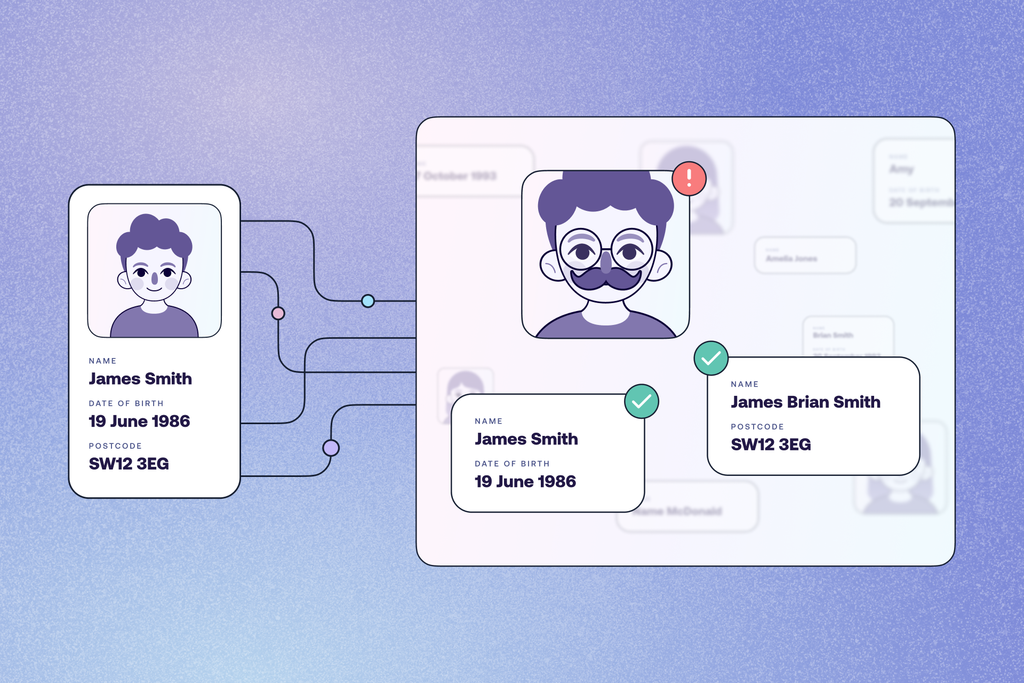
A fake document, compromised credential, suspicious device cluster or synthetic identity should not have to be rediscovered by every bank, fintech and IDV provider separately.
That is the weakness in today’s model.
Today’s fraud data sharing depends on legacy databases, manual reporting and systems designed for a paper-document world.
The next generation needs real-time signals that work across digital IDs, wallets, documents, devices and relying parties, without creating giant honeypots of personal data.
This is one of the areas we’re most excited about.
Vouchsafe is building Radar, a next-generation fraud data sharing network for modern identity evidence (more on that soon).
What good looks like
Good identity infrastructure will be built for three things: many kinds of evidence, AI-era fraud, and shared fraud intelligence.
It will accept more than passports and driving licences.
It will work with reusable digital IDs, wallets, official data, attributes and vouches.
It will come with next-gen, real time fraud controls built in, that helps firms learn from each other’s fraud signals without legacy burdens.
This is where Vouchsafe has been heading for a long time.
Chloe Coleman, Jaye Hackett and Nkechi Anyanwu are attending Money20/20 from 2-4 June. Book a conversation with us in the app or via LinkedIn.